
CRUE and Banco Santander renew Erasmus and microcredential scholarships
The agreements, backed by the Ministerio de Ciencia, Innovación y Universidades, allocate 5.9 million euros to more than 3,500 Erasmus scholarships and 7,800 grants to study microcredentials this academic year.
Redacción · Published on September 21, 2026
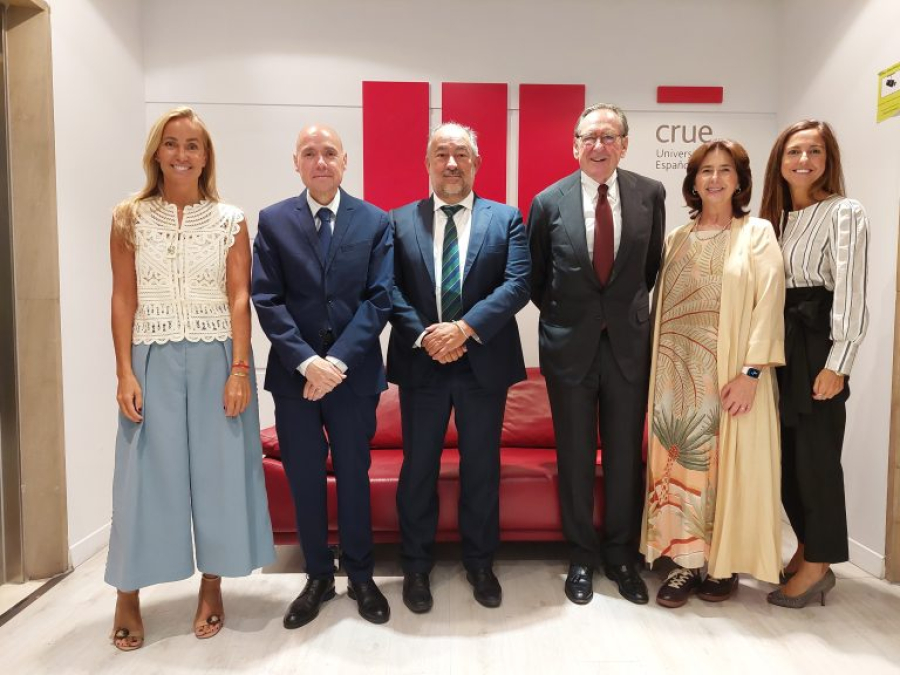
The Conference of Rectors of Spanish Universities (CRUE) and Banco Santander have renewed, with the institutional support of the Ministerio de Ciencia, Innovación y Universidades, the Becas Santander para Erasmus and Becas Santander Microcredenciales programs, according to the statement issued by the Universidad de Córdoba.
The agreements provide for an allocation of 5.9 million euros to fund more than 3,500 Erasmus grants, of 1,000 euros each, during the new academic year. In addition to this amount, there are 7,800 grants of 300 euros intended for taking university microcredentials, short and specialized courses designed to update knowledge.
The signing ceremony was held at the CRUE headquarters and was attended by José Julián Garde López-Brea, president of CRUE and rector of the Universidad de Castilla-La Mancha; Matías Rodríguez Inciarte, president of Santander Universidades, and Francisco García Pascual, secretary general of Universidades. They were accompanied by María Teresa Lozano, secretary general of CRUE; Susana García-Espinel, director of Santander Universidades and Universia España, and Amaya Román Palero, head of Social Impact and Grants at Santander Universidades and Universia España, among other attendees.
Garde argued that «mobility should not depend on families' economic capacity» and summarized the meaning of both programs: «Erasmus expands the University's geographic borders; microcredentials expand its temporal borders. And both initiatives ultimately expand people's opportunities».
Rodríguez Inciarte, for his part, noted that the two programs «respond to different but complementary moments in people's educational path», by combining international academic experience with flexible training for those who need to update their knowledge during their professional life.
García Pascual stressed the importance of maintaining the Erasmus program as part of the European university ecosystem, which he considered «vital for building European citizenship», and highlighted that the flexibility of microcredentials «makes it easier for graduates to enter the job market with more skills and allows for the requalification of the working population».
The agreements provide for an allocation of 5.9 million euros to fund more than 3,500 Erasmus grants, of 1,000 euros each, during the new academic year. In addition to this amount, there are 7,800 grants of 300 euros intended for taking university microcredentials, short and specialized courses designed to update knowledge.
The signing ceremony was held at the CRUE headquarters and was attended by José Julián Garde López-Brea, president of CRUE and rector of the Universidad de Castilla-La Mancha; Matías Rodríguez Inciarte, president of Santander Universidades, and Francisco García Pascual, secretary general of Universidades. They were accompanied by María Teresa Lozano, secretary general of CRUE; Susana García-Espinel, director of Santander Universidades and Universia España, and Amaya Román Palero, head of Social Impact and Grants at Santander Universidades and Universia España, among other attendees.
Garde argued that «mobility should not depend on families' economic capacity» and summarized the meaning of both programs: «Erasmus expands the University's geographic borders; microcredentials expand its temporal borders. And both initiatives ultimately expand people's opportunities».
Rodríguez Inciarte, for his part, noted that the two programs «respond to different but complementary moments in people's educational path», by combining international academic experience with flexible training for those who need to update their knowledge during their professional life.
García Pascual stressed the importance of maintaining the Erasmus program as part of the European university ecosystem, which he considered «vital for building European citizenship», and highlighted that the flexibility of microcredentials «makes it easier for graduates to enter the job market with more skills and allows for the requalification of the working population».