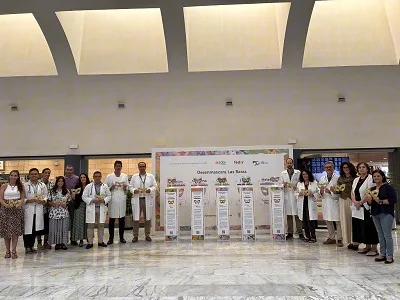
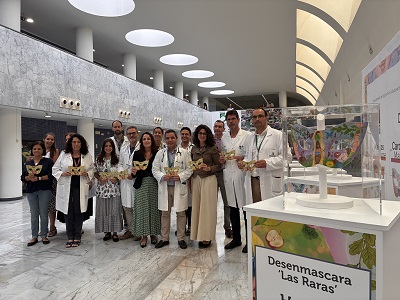
The main lobby of the Reina Sofía University Hospital in Córdoba displays five masks about the reality of rare diseases, with videos of patients and well-known people who have engaged with their testimonies.
InfoCórdoba newsroom
·
Photo: Hospital Universitario Reina Sofía
The Reina Sofía University Hospital in Córdoba is hosting the exhibition "Desenmascara las Raras" in its main lobby, which can be visited until October 12. The display is an initiative of the biopharmaceutical company Sobi, in collaboration with the Spanish Federation of Rare Diseases (FEDER) and patient associations, including the Familial Chylomicronemia Syndrome (FCS) association.
Five masks and five stories
The exhibition brings together five masks created by artist Elsa Suárez, each based on the story of a person with a different rare disease: Laura García, Carolina Martín, Carlos Infantes, Helena Carpio and Marcos Guadalupe. The themes addressed include eating problems in metabolic diseases, the impact of diagnosis, the role of the family and raising awareness of joint pain in hemophilia.
Well-known people from culture, sport and communication have also joined the campaign, such as chef Carlos Maldonado, actress Laura Ramos, Fabiola Martínez (president of the Kike Osborne Foundation), journalist Patricia Pardo and footballer Luis Milla, who have approached the testimonies of people with congenital coagulopathies, paroxysmal nocturnal hemoglobinuria, chylomicronemia syndrome, glutaric aciduria type 1 or spastic paraparesis. The videos of these encounters can be seen at the exhibition itself.
Facts about rare diseases
According to the campaign, more than half of families with rare diseases wait more than six years to obtain a diagnosis, only 6% of these conditions have a specific treatment and 70% manifest during childhood. FEDER adds that 43% of people with rare diseases have felt discrimination because of their condition and that only 20% of these conditions are the subject of research.
The hospital's deputy medical director, Joaquín Fernández, highlights the importance of coordinated work between pediatric and adult specialists to respond to the complexity of these conditions, both in care and in research.
The case of Familial Chylomicronemia Syndrome
FCS is a genetically based disease that reduces the ability to metabolize fats from food, due to alterations in the production of the enzyme lipoprotein lipase (LPL) or of proteins related to its function. This causes very high levels of triglycerides in the blood, with the presence of chylomicrons that give plasma a milky appearance, and can lead to chronic and recurrent pancreatitis.
María Ángeles Garrido, vice president of the Familial Chylomicronemia Syndrome Patient Association, explains that "it is a disease that carries a great emotional and social impact on people. Such important dietary restrictions greatly limit our social activity, since we live in a society where social relationships, family celebrations, and so on, revolve around food."
The opening was attended by Joaquín Fernández, deputy medical director of the hospital; Rosa Elba González, board member of FEDER; María Ángeles Garrido, vice president of the FCS patient association; and Raquel Fernández, associate director of Access and Institutional Relations at Sobi Iberia.