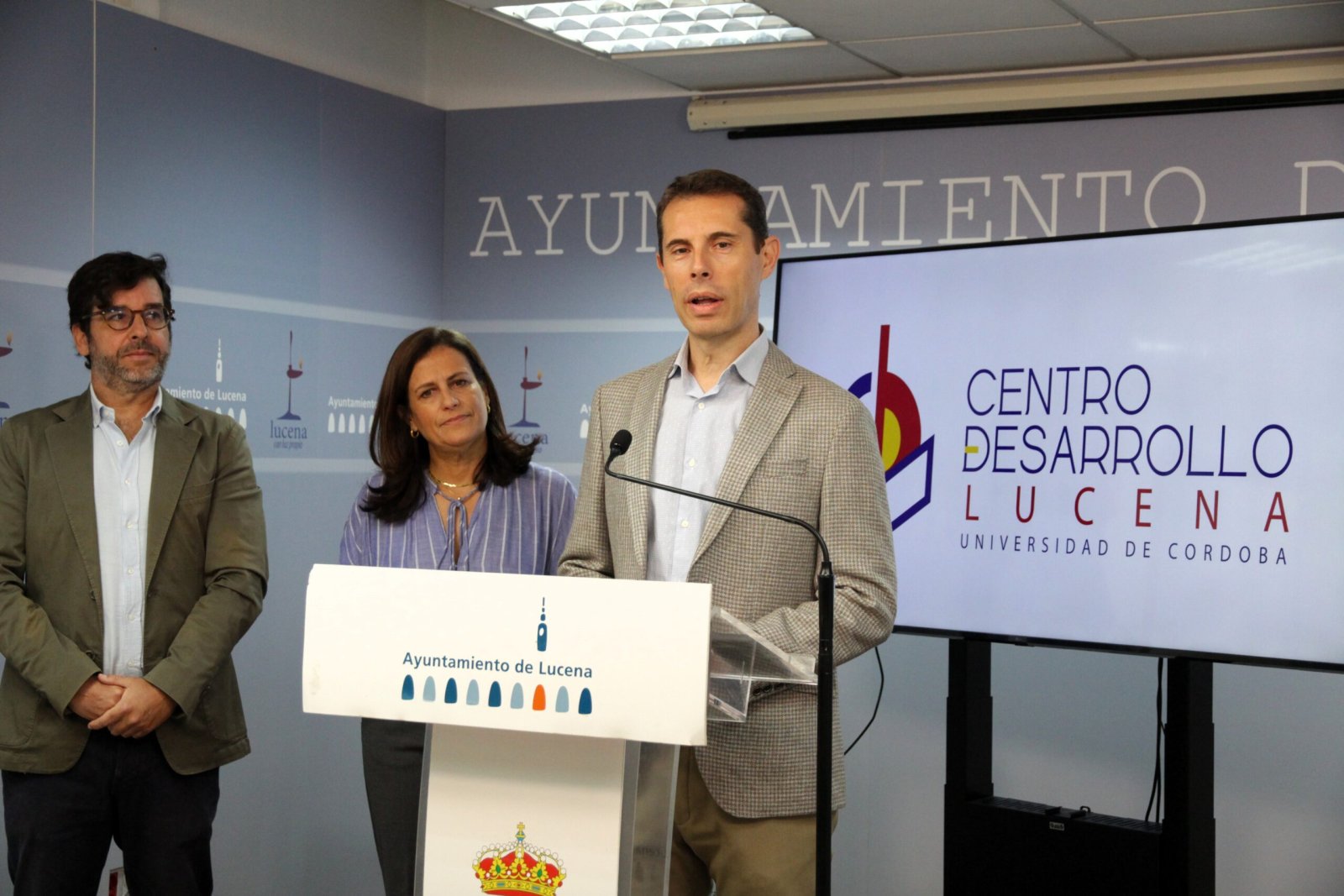
The Centro de Desarrollo Universitario de Lucena presents its programme for 2026 and 2027 and the results of the Aquadomus project on water and energy.
InfoCórdoba newsroom
·
Photo: Ayuntamiento de Lucena
The Centro de Desarrollo Universitario de Lucena now has a roadmap for the next two academic years: 21 initiatives spread across three axes, including six activities totalling 80 hours of training. The programme, presented alongside the centre's new director, Francisco José Rey Carmona, focuses on training, research and knowledge transfer, and social and cultural action.
Training for employment and artificial intelligence
The six training activities have been designed with content agreed with the business community to respond to its needs. They are aimed at improving employability and the professional skills of citizens, and include specific training in artificial intelligence for municipal staff.
The second block brings together research and transfer projects in areas such as sustainability, social inclusion, tourism, education and health. Among the initiatives are Aquadomus, the Observatorio Social de Lucena, Subbética Tourscope, the Salón del Estudiante and activities related to physical exercise and cancer. To this is added a line of social and cultural work with proposals for scientific and cultural outreach, health and inclusion.
A system to measure water and energy in sports facilities
In this framework, the results of Aquadomus were presented, an applied research project on the efficient management of water and energy in municipal sports facilities. It was presented by Juan Manuel Díaz Cabrera, associate professor of Electrical Engineering at the Universidad de Córdoba, director of the Cátedra Eprinsa de Transformación Digital and member of the centre's advisory council.
The initiative, funded by the Junta de Andalucía within the Plan Sequía, has had the collaboration of specialised companies and entities. In Lucena, the historical records of water and energy consumption for the period 2018-2025 and data on the use of the spaces have been studied, and a monitoring system has been installed in the municipal swimming pool to control water consumption in the showers.
With that information, an open-source digital platform has been developed that allows data to be visualised, prediction algorithms to be applied and anomalies in consumption to be detected. According to Díaz Cabrera, the pilot experience improves the monitoring of facilities and could be extended to other municipal spaces, with the aim of facilitating the early detection of leaks or unusual consumption.
Rey Carmona, associate professor at the Universidad de Córdoba in the Facultad de Derecho, takes over from professor Maribel Rodríguez Zapatero. In his speech he thanked her for the trust placed in him and acknowledged the work of his predecessor, and noted that «the centre's mission is to act as a link between society and the University, identifying the needs of the environment and making the institution's teaching and research resources available to companies, administrations and groups». The councillor for Education, Miriam Ortiz, accompanied the new director at the presentation, as indicated by the Ayuntamiento de Lucena.
Share this story
Breaking news from News, on your phone
An alert only when something can't wait. Free, no account needed.
On iPhone, alerts only arrive if you first add InfoCórdoba to your Home Screen.
How to do it, step by step
This browser can't receive alerts. Try another one, such as Chrome or Safari.
You've blocked alerts from InfoCórdoba in this browser. You can turn them back on in its settings.
How to do it, step by step