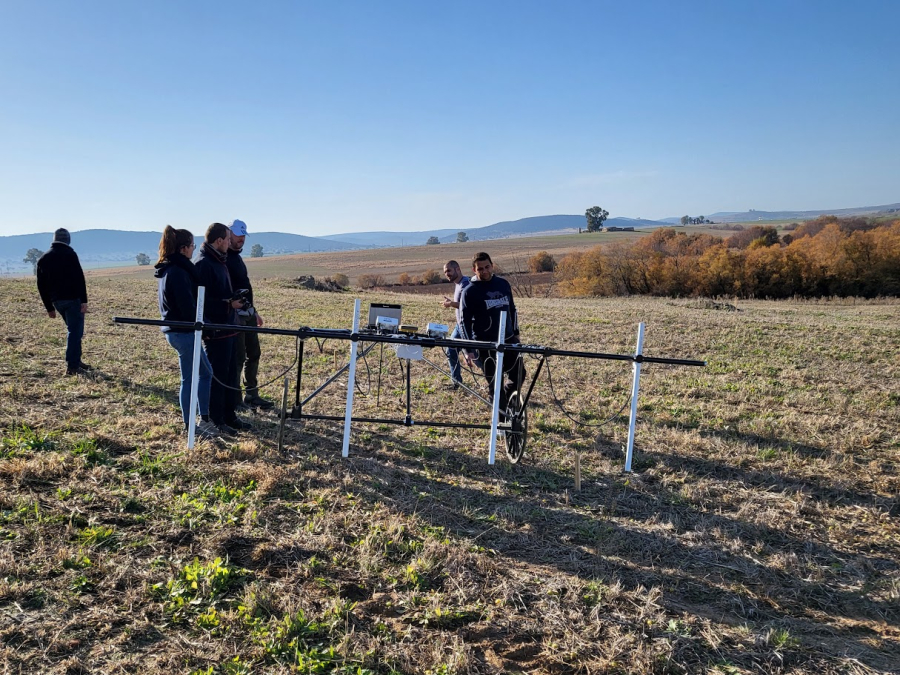
A University of Córdoba study detects beneath the ground, next to the Mellaria site, a 48-metre-long building with eight rooms, a bath and a courtyard that served as a stop for travellers on the route between Córdoba and Mérida.
Photo: Universidad de Córdoba · Gabinete de Comunicación
The HUM 1150-Patricia Unit Group of the University of Córdoba (UCO) has identified in Fuente Obejuna a building that served as a service area for those travelling the Roman road between Córdoba and Mérida. The discovery was achieved with a non-invasive geophysical analysis, that is, without excavating, based on subsoil variations measured with geomagnetic data.
What has been found
The detected structure is 48 metres long and occupies about 1290 square metres. It is located on the outskirts of the urban centre of Mellaria, very close to present-day Fuente Obejuna, and next to the Roman road. According to the research, the building would have eight rooms, a bath and a large courtyard that could be interpreted as a stable or carriage parking area for the rest of the draught animals.
A stop for ordinary travellers
Compared with other more monumental Roman mansions further from the main roads, this one corresponds, by size and location, to those that the literature classifies as standard class. They would follow a military barracks model and would be intended for ordinary travellers, troops and service personnel. Being on the periphery and next to the road, it allowed quick access, supply and changing horses without bringing carriages and animals into the interior of the city.
A broader logistical landscape
The ground anomalies detected around it suggest that the complex extended beyond this building. About fifty metres to the north there would be another first-class building, connected to the previous one. The identification represents one more step towards understanding the Roman postal service, the cursus publicus, in the Iberian Peninsula.
Origin of the study
The research was published in the journal Journal of Archaeological Science: Reports and is the result of the geomagnetic surveys of the Ager Mellariensis project (II. AEI PID2020-114331 GB-I00) at the Mellaria site between 2021 and 2023. Signed by Miriam González Nieto.
Share this story
Breaking news from News, on your phone
An alert only when something can't wait. Free, no account needed.
On iPhone, alerts only arrive if you first add InfoCórdoba to your Home Screen.
How to do it, step by step
This browser can't receive alerts. Try another one, such as Chrome or Safari.
You've blocked alerts from InfoCórdoba in this browser. You can turn them back on in its settings.
How to do it, step by step