
Diputación and UCO will research the water of four reservoirs to improve its purification
An agreement between Emproacsa and the Universidad de Córdoba will launch a project to study the reservoirs of Iznájar, Puente Nuevo, Sierra Boyera and Martín Gonzalo and anticipate changes in the water reaching the treatment plants.
Redacción · Published on September 21, 2026
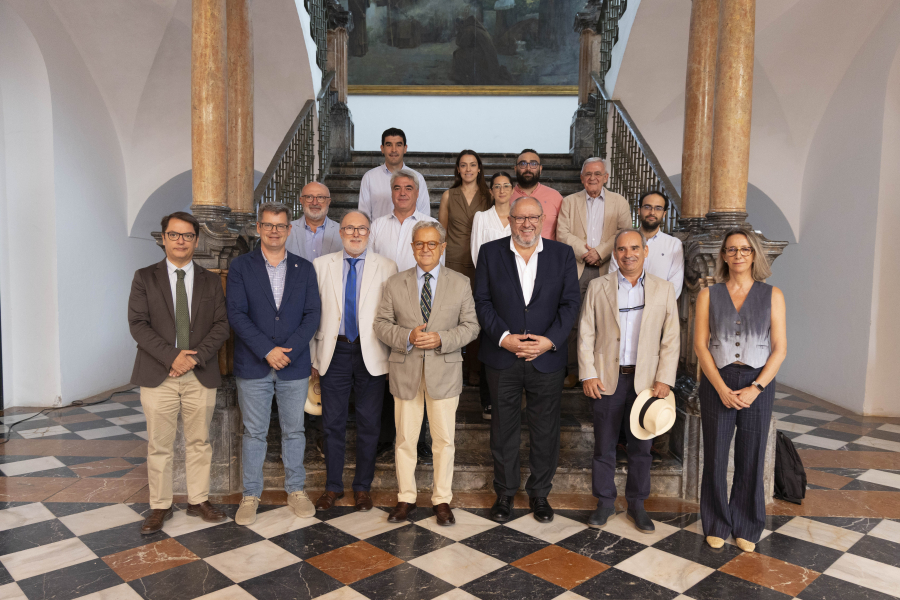
The Diputación de Córdoba, through its Empresa Provincial de Aguas (Emproacsa), and the Universidad de Córdoba (UCO) have signed a collaboration agreement launching a research project on the reservoir water bodies of the province. The goal is to improve knowledge of these reservoirs and develop tools to anticipate their evolution and optimize the treatment of drinking water.
The project, called «Caracterización y modelización de las masas de agua embalsadas y optimización de los tratamientos en las ETAP de la provincia», will focus on the Iznájar, Puente Nuevo, Sierra Boyera and Martín Gonzalo reservoirs. As explained by the president of the Diputación, Salvador Fuentes, both the basins that feed these reservoirs and the internal dynamics of their waters will be analyzed, along with their relationship to the processes later applied at the drinking water treatment plants (ETAP).
Fuentes recalled that Emproacsa provides service to nearly 370,000 users, which according to the president makes it necessary to have new knowledge and prediction tools to address the variability of hydrological and environmental conditions. One of the goals, he noted, is to move toward more predictive water management through models that represent the functioning of each reservoir and simulate different future scenarios.
Fuentes pointed out that, based on the results, predictive operational strategies could be defined, supported by artificial intelligence and new treatment technologies, including ultrafiltration, nanofiltration, partial reverse osmosis and advanced oxidation processes.
The agreement will last one year, extendable to four, and will involve the participation of the Escuela Politécnica de Bélmez. The rector of the UCO, Manuel Torralbo, highlighted the collaboration channels opened between the university and the provincial institution.
Three work phases
The research is structured in three phases. The first will analyze the river basins that feed the four reservoirs: environmental, climate and cartographic information will be gathered and integrated into a geographic information system, the basins and sub-basins will be delimited, and the terrain, land uses and main watercourses will be studied.
The second phase will be devoted to characterizing the reservoirs themselves, with a sampling network, on-site measurements and laboratory analysis to study water distribution and the processes of stratification, mixing and internal circulation.
The third phase will carry these results over to water treatment: information on the functioning of the ETAP will be gathered, and how the current treatment processes respond to the different conditions of the water coming from the reservoirs will be analyzed.
The project, called «Caracterización y modelización de las masas de agua embalsadas y optimización de los tratamientos en las ETAP de la provincia», will focus on the Iznájar, Puente Nuevo, Sierra Boyera and Martín Gonzalo reservoirs. As explained by the president of the Diputación, Salvador Fuentes, both the basins that feed these reservoirs and the internal dynamics of their waters will be analyzed, along with their relationship to the processes later applied at the drinking water treatment plants (ETAP).
Fuentes recalled that Emproacsa provides service to nearly 370,000 users, which according to the president makes it necessary to have new knowledge and prediction tools to address the variability of hydrological and environmental conditions. One of the goals, he noted, is to move toward more predictive water management through models that represent the functioning of each reservoir and simulate different future scenarios.
Fuentes pointed out that, based on the results, predictive operational strategies could be defined, supported by artificial intelligence and new treatment technologies, including ultrafiltration, nanofiltration, partial reverse osmosis and advanced oxidation processes.
The agreement will last one year, extendable to four, and will involve the participation of the Escuela Politécnica de Bélmez. The rector of the UCO, Manuel Torralbo, highlighted the collaboration channels opened between the university and the provincial institution.
Three work phases
The research is structured in three phases. The first will analyze the river basins that feed the four reservoirs: environmental, climate and cartographic information will be gathered and integrated into a geographic information system, the basins and sub-basins will be delimited, and the terrain, land uses and main watercourses will be studied.
The second phase will be devoted to characterizing the reservoirs themselves, with a sampling network, on-site measurements and laboratory analysis to study water distribution and the processes of stratification, mixing and internal circulation.
The third phase will carry these results over to water treatment: information on the functioning of the ETAP will be gathered, and how the current treatment processes respond to the different conditions of the water coming from the reservoirs will be analyzed.