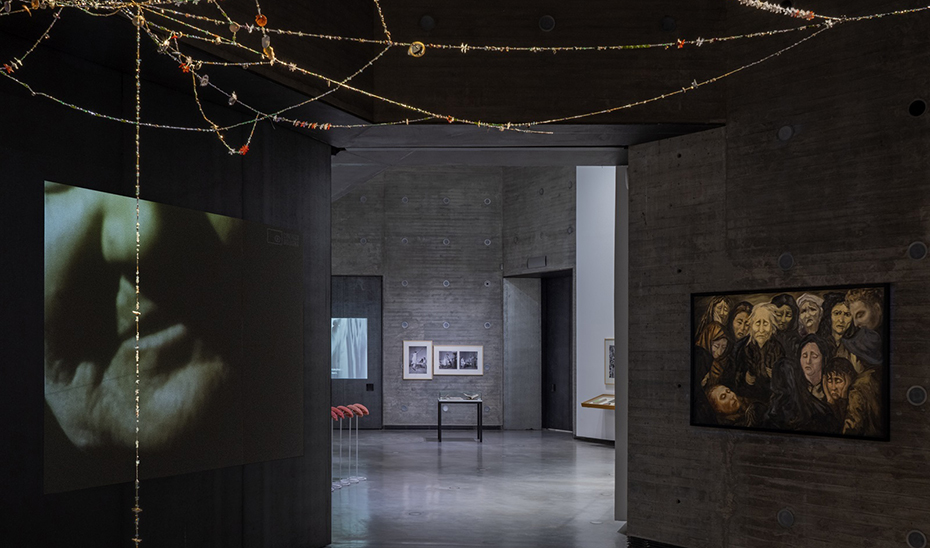
The C3A explores the enduring relevance of tarantism and southern folklore until March 2027
The Centro de Creación Contemporánea de Andalucía (C3A) in Córdoba presents 'La picadura de la tarántula: sur y folclore', an exhibition that brings the studies of anthropologist Ernesto de Martino into dialogue with works by contemporary Andalusian artists. It can be visited in room T4 until March 28, 2027.
Redacción
·
·
Photo: Junta de Andalucía · Portavoz
Update of October 17, 06:28
The note specifies that the exhibition opens today, October 16, 2026, and adds the name of the C3A press curator, Trini Salamanca, as well as a link to download high-resolution images, with photography credits by Juan López.
The attached material includes data that the published news item did not cover: the exhibition includes pieces from the Universidad Popular del Mediodía, a project of La Madraza - Centro de Cultura Contemporánea de la Universidad de Granada based at the Casa de Porras, in the Albaicín, whose name takes up the notion of 'Mediodía' from the Arabist Rodolfo Gil Benumeya. The artists' birthplaces and years are also detailed: María Alcaide (Huelva, 1992), María Rosa Aránega (Almería, 1995), Mateo Chica (Madrid, 1998) and Manuel Zapata Vázquez (Sevilla, 1991).
The list of institutions and archives is expanded with the Biblioteca Histórica 'Marqués de Valdecilla' of the UCM and the Archivo Franco Pinna, and a script and research by Ana Vila is attributed to 'Rocío' (1980).
The Centro de Creación Contemporánea de Andalucía (C3A) now hosts the exhibition 'La picadura de la tarántula: sur y folclore', which can be visited in room T4 until March 28, 2027. The show, curated by Lluís Alexandre Casanovas Blanco, explores the currency of the thought of the Italian anthropologist Ernesto de Martino (1908-1965) and its relationship with contemporary artistic creation produced from the south.
Original materials and new productions
The exhibition starts from the research that De Martino carried out in the 1950s in southern Italy, taking as a reference the writings of Antonio Gramsci and the work of the poet and painter Carlo Levi, exiled to Lucania in 1935. The curator notes that «Levi discovers a society crossed by precariousness, isolation and poverty, in which systems of beliefs and cultural practices organize collective life».
The show focuses on the study of tarantism, a supposed condition attributed to the tarantula bite whose symptoms of convulsion or trance were linked to rituals of music and dance. De Martino addressed this phenomenon in 'La terra del rimorso' (1961), drawing on sources that documented similar cases in Spain. The exhibition brings together medical files and treatises that recorded cases of tarantism in the Iberian Peninsula in the 18th and 19th centuries, with records reaching up to the mid-20th century.
Cinema, archives and contemporary artists
The original materials from De Martino's expeditions are placed in dialogue with films, photographs, documents and contemporary works. Among the audiovisuals are works by filmmakers such as Lino Del Fra, Giuseppe Ferrara, Cecilia Mangini or Gianfranco Mingozzi. The show also incorporates the gaze that, from the late seventies and early eighties, Andalusian filmmakers directed toward pilgrimages and rituals, with films such as 'Rocío' (1980), by Fernando Ruiz Vergara, and 'Tierras de Málaga' (1979), by the Cooperativa de Cine de Málaga.
The new productions include works by María Alcaide, María Rosa Aránega, Mateo Chica and Manuel Zapata Vázquez, the latter two with commissions specifically for the show. The curator explains that these artists approach folklore «as an unstable field, in dispute, marked by conflicts of class, gender, territory and memory». The exhibition features materials from institutions such as the Archivo Nacional, the Biblioteca Histórica Municipal de Madrid, the Fondazione Carlo Levi, the Cineteca de Bologna, the Filmoteca de Andalucía or the Istituto Centrale per il Patrimonio Immateriale (Roma).
Visit
The show can be seen in room T4 of the C3A, under the Consejería de Cultura, Patrimonio Histórico y Deporte, until March 28, 2027.
Share this story
Breaking news from News, on your phone
An alert only when something can't wait. Free, no account needed.
On iPhone, alerts only arrive if you first add InfoCórdoba to your Home Screen.
How to do it, step by step
This browser can't receive alerts. Try another one, such as Chrome or Safari.
You've blocked alerts from InfoCórdoba in this browser. You can turn them back on in its settings.
How to do it, step by step